

Healthcare: Prescriber Data & AI Outreach Engine

Automation Atlas
June 23, 2026
The Problem: A Slow, Manual Way to Find Qualified Leads
A fast-growing healthcare company was building its provider network across the United States, and its sales team was spending most of its time on the least valuable part of the job: just finding the right people to talk to.
The way they did it was the way most go-to-market teams do it — and it was painfully inefficient:
- Fragmented scraped lists. Reps stitched together leads from a patchwork of scraped and purchased lists, each one a partial, overlapping slice of the market. No single list was complete, and none of them could tell you who actually prescribed in the company's target category.
- Manual research, one lead at a time. For every promising name, a rep then went hunting — opening tabs, reading profiles, checking affiliations and publications — to figure out whether the provider was even a fit and what to say to them. Hours of work to qualify a handful of leads.
- Wasted and risky touches. Reps re-pitched providers the company already served, and outreach in a regulated healthcare context carried compliance risk that ad-hoc lists never accounted for.
The result was a sales team doing detective work instead of selling, with a pipeline that was slow to fill and impossible to scale. There was a far more efficient way to do this — and that was the mandate Automation Atlas took on: let AI find, qualify, and research the right providers automatically, so the sales team gets a ready, evidence-backed list instead of building one by hand.
The AI Solution: Map the Market, Qualify It, Enrich It, Reach It
Automation Atlas built an end-to-end engine with AI as the throughline at every stage. Artificial intelligence maps the entire national provider market from public records, qualifies it down to the precise targets, enriches each contact with grounded research, and runs automated, AI-personalized cold outreach, all on a compliance-first foundation.
The system doesn't sample the market. It reconstructs a near-complete national census of US healthcare providers, then lets AI do the narrowing, the reasoning, and the writing.
Three distinct Anthropic Claude call sites power the intelligence layer, each swappable by configuration and each designed to degrade gracefully with audited fallbacks:
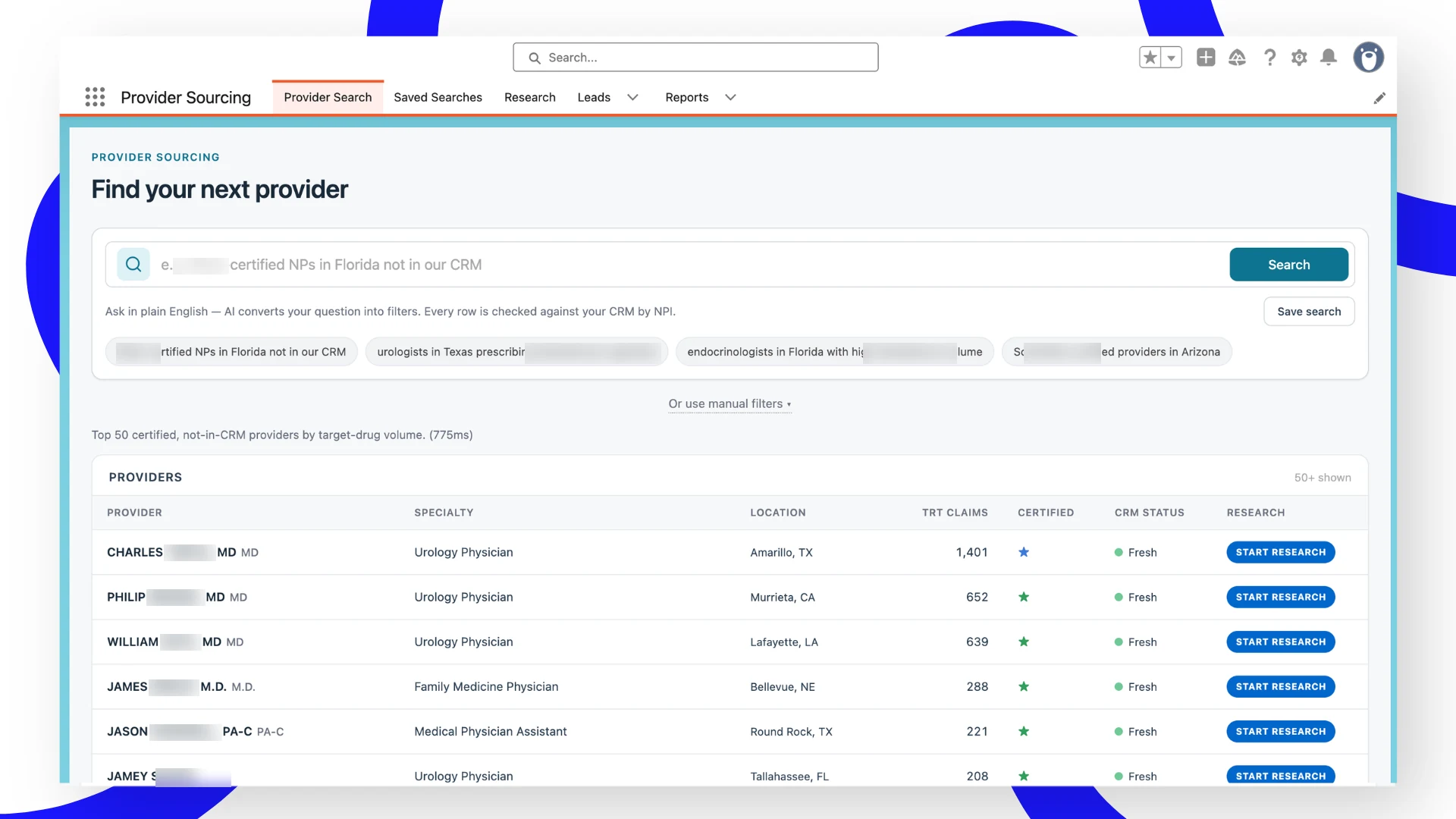
- Natural-language market search — a rep types plain English; Anthropic's Claude turns it into validated, structured filters over a multi-million-provider dataset.
- Agentic research briefs — Claude synthesizes grounded, cited sales briefs from live public web research.
- AI-personalized outreach — Anthropic's fast Claude Haiku model (Claude Haiku 4.5) writes the human-sounding opener for every provider.
How It Works
1. The Data Foundation — The Entire Provider Market, Not a Sample
The engine is built entirely from publicly available government and public healthcare records — national provider registries plus public prescribing data — assembled into a near-complete national census of the provider market:
- ~7.2M active US healthcare providers
- ~1.38M prescribers with public prescribing-volume data
- ~26.8M granular provider-drug records behind them
That's the whole market in one place — every provider, with real prescribing evidence attached — instead of a purchased slice.
And it's compliant by design:
Nothing in the database identifies a patient. There is no patient PHI — only public, professional provider data.
2. AI Targeting & Qualification — From ~7.2M Down to the Right Prescribers
A multi-layer funnel narrows the full census to a precise, evidence-carrying pool. Every surviving provider arrives with a reason attached.
- Prescribing-signal qualification. A curated name-pattern table drives a two-stage filter that matches target-category drugs and aggregates them per provider, producing each qualifying provider's claim count, fills, dollar volume, and beneficiary count. Providers are ranked by real observed prescribing volume, highest first.
- Specialty qualification. A tiered taxonomy (primary / secondary / adjacent) matches against all of a provider's specialty slots, catching the right prescribers for the company's therapy area even when they don't appear in public prescribing data, such as those with commercially-insured patient panels.
- Certification qualification. Public specialty-certifying-organization directories are consolidated and probabilistically matched back to each provider's registry ID, with match score and method retained for audit, a strong "already works in this modality" fit signal.
- Suppression. The company's own customer records are mirrored into a dedup-decision table with a
safe_to_contactflag. Any existing relationship excludes a provider, so outreach only ever touches fresh prospects.
Then comes the part that makes the market navigable for a non-technical rep. With natural-language market search, a rep types a request in plain English and Anthropic's Claude parses it into validated structured filters — specialty, state, volume floor, certifying organization with fuzzy normalization, "not already a customer" — runs the query, and returns an interpreted map of how it understood the request, for full transparency.
3. AI Contact Enrichment — A Cited Brief for Every Provider
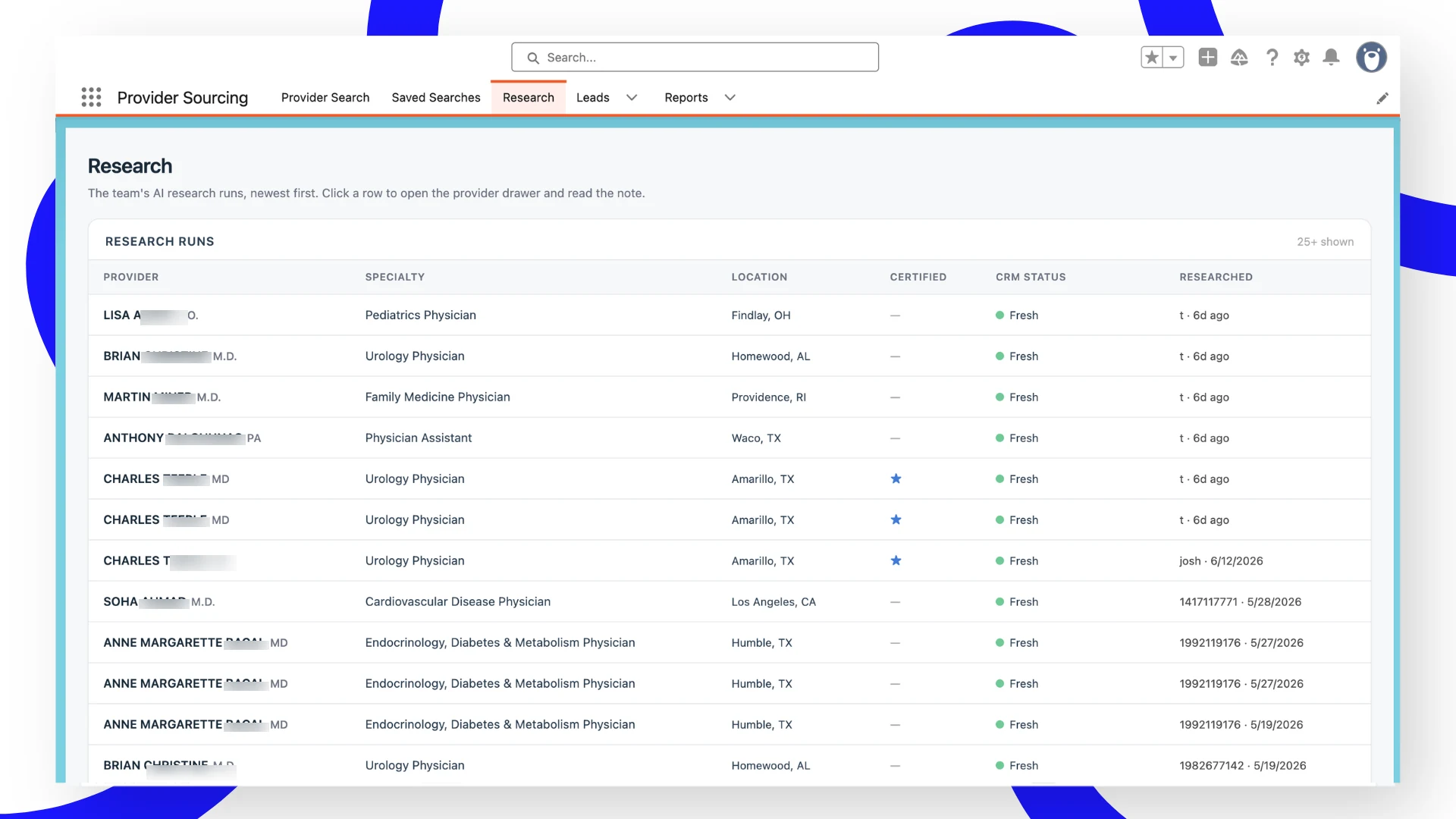
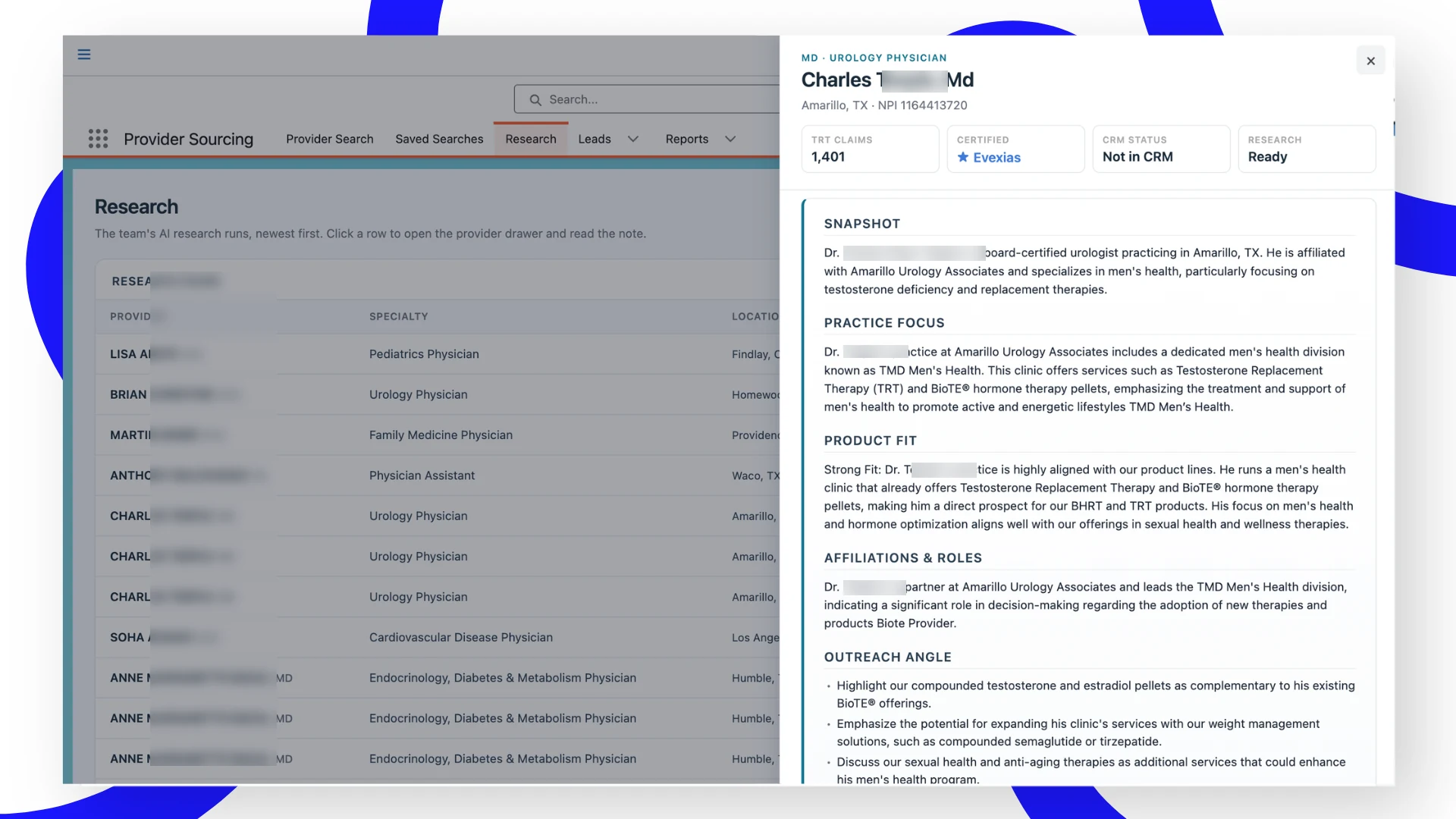
Before a single message goes out, the engine can build a research brief on any provider. An agentic workflow runs several public web searches in parallel (practice and role, publications, affiliations and news, sanctions), ranks the most relevant sources, and hands them to Anthropic's Claude to synthesize a short, cited sales brief: Snapshot, Affiliations, Publications, Recent Activity, Sales Angle, and Flags.
The anti-hallucination rules are strict and non-negotiable:
- An inline citation for every claim.
- Unsupported sections are omitted, never guessed.
- The model is instructed to never speculate, and runs at low temperature for consistency.
It turns hours of manual research into seconds of grounded, verifiable intelligence — for every provider, on demand.
4. Automated AI Outreach — Human-Sounding Copy, Compliance Built In
Qualified providers enter outreach with a click or a bulk upload and flow through an automated pipeline that makes sure no one is ever messaged twice, has the AI write a personalized opener, sends it, and logs every step for a full audit trail.
The personalization brain is Anthropic's fast Claude Haiku model (Claude Haiku 4.5). It writes an exactly 2–3 sentence opener grounded in a real signal about that specific provider, and the prompt is engineered specifically not to sound like AI:
- It bans buzzwords ("synergy," "ROI," "leverage," "world-class," "AI-powered," "10x").
- It bans em-dashes, called out in the prompt as the single most reliable AI tell in cold email.
- If the available context is too thin to write something genuine, the model skips the lead rather than ship a weak email.
The pipeline is built to never stall: if the AI is ever unavailable, a reliable fallback still ships the message and flags it for later re-personalization, so outreach keeps moving no matter what.
Compliance is woven through the entire outreach layer:
- CAN-SPAM — a physical address and a working unsubscribe in every template.
- Native suppression — do-not-contact and unsubscribe handling, with a unique index that makes duplicate enrollment impossible.
- Jurisdictional awareness — state medical-board restrictions on out-of-state commercial outreach are flagged before scaling.
- HIPAA-aware messaging layer — a separate SMS capability is built consent-first: prior express consent, immediate and indefinite opt-out, quiet-hours enforcement, per-state law handling, PHI-minimized message bodies that never reveal condition or treatment, phone numbers redacted to last-4 in logs, and an encrypted audit trail.
Operators stay in the loop end to end: opens, clicks, replies, bounces, and unsubscribes are captured via webhook; a reply triggers an instant notification; a daily 8am digest summarizes activity; and a reconciliation job every six hours corrects any drift.
A provider's journey through the system reads at a glance:
Not contacted → In progress → Interested, with Do not contact enforced automatically at every step.
Results & Scale
The engine's power is in its completeness, its grounding, and its design.
| Capability | What it delivers |
|---|---|
| Market visibility | ~7.2M providers, the full national census, not a sample |
| Prescribing evidence | ~1.38M prescribers across ~26.8M provider-drug rows |
| Qualification | Prescribing-signal, specialty, and certification layers, deduped against existing customers |
| AI research | Parallel public-web search synthesized into a short, cited brief per provider |
| AI outreach | Concise, human-sounding Claude Haiku openers grounded in a real signal |
| Compliance | No patient PHI, CAN-SPAM, DNC/opt-out, HIPAA-aware, jurisdiction-flagged |
The search and qualification engine is deployed, live, and operational. The provider-sourcing application has reached a tested sandbox deployment, and rep rollout is in early pilot. The AI outreach pipeline is fully built and wired, with grounded personalization and graceful fallbacks in place.
The Bottom Line
Most healthcare go-to-market teams buy a slice of the market and hope it converts. Automation Atlas gave the healthcare company something categorically different: a near-complete map of the entire national provider market, an AI layer that narrows millions of providers down to exactly the right prescribers for its therapy area, grounded and cited research on each one, and AI-personalized outreach that sounds human and stays compliant.
The list isn't bought. It's reasoned — from ~7.2 million providers down to the precise pool worth a real conversation, with AI doing the seeing, the qualifying, the researching, and the writing.
It is a research analyst, a market-mapping team, and a compliant outreach desk, rebuilt as one AI-driven engine, and it runs for the price of a few dollars a day.
More case studies
See how Automation Atlas builds AI engines that work

Financial Services: Meeting Booking Recovery AI Dialer
How Automation Atlas built an AI voice agent — powered by Anthropic's fast Claude Haiku model and an ElevenLabs voice — that instantly calls…
Automation Atlas
June 22, 2026

Private Equity: Accounting Firm Roll-up
How Automation Atlas built an AI-powered deal-sourcing engine that maps, scores, and reaches the entire national accounting-firm market for…
Automation Atlas
June 18, 2026