

Private Equity: Accounting Firm Roll-up

Automation Atlas
June 18, 2026
When a private-equity-backed family office set out to roll up the deeply fragmented U.S. accounting and tax-preparation market, it ran into a problem that money alone could not solve: how do you find every acquirable firm in the country before your competitors do?
The target universe — independent CPA practices, tax shops, and advisory firms — is enormous, privately held, and almost entirely invisible to conventional deal-sourcing tools. The numbers that actually matter to a buyer (revenue, profitability, owner retirement intent, service mix) are rarely public. Generic deal databases were built for venture and large-cap private equity; they competed on "200+ analysts and a 20-year head start," but they offered almost no coverage of a sub-$10M CPA firm in a secondary market. And the rival referral agents the family office was up against were still working from spreadsheets and off-the-shelf CRMs.
The California Family Office did not need another subscription. It needed an edge — a proprietary, AI-driven engine that could see the entire market, qualify it intelligently, and reach the right decision-makers first.
The AI-Powered Solution
Automation Atlas built that engine: an end-to-end, AI-powered deal-sourcing system that maps the national accounting-firm landscape, scores and qualifies every firm against the buyer's mandate, enriches verified decision-maker contacts, and orchestrates personalized outreach — automatically, at a scale no analyst team could match.
The throughline is artificial intelligence at every stage:
- AI sourcing from publicly available government and public records to assemble the complete target universe.
- An AI scoring and qualification model that estimates each firm's revenue and profitability and evaluates fit against the buy-box.
- AI-enriched, verified contact and decision-maker data so every qualified firm comes with a real person to reach.
- Automated, AI-personalized outreach campaigns that move firms through a tracked pipeline from first touch to interested.
Under the hood, the engine runs on Anthropic's Claude models — the same frontier AI Automation Atlas builds every system on. Claude Sonnet 4.6 powers the judgment-heavy work: reading and interpreting each firm's website, inferring its specialization, and qualifying it against the buy-box. Claude Haiku handles the high-volume, repetitive tasks — classifying, tagging, and normalizing hundreds of thousands of records fast and cost-efficiently. Routing each job to the right model is what lets the system reason like an analyst and operate at national scale.
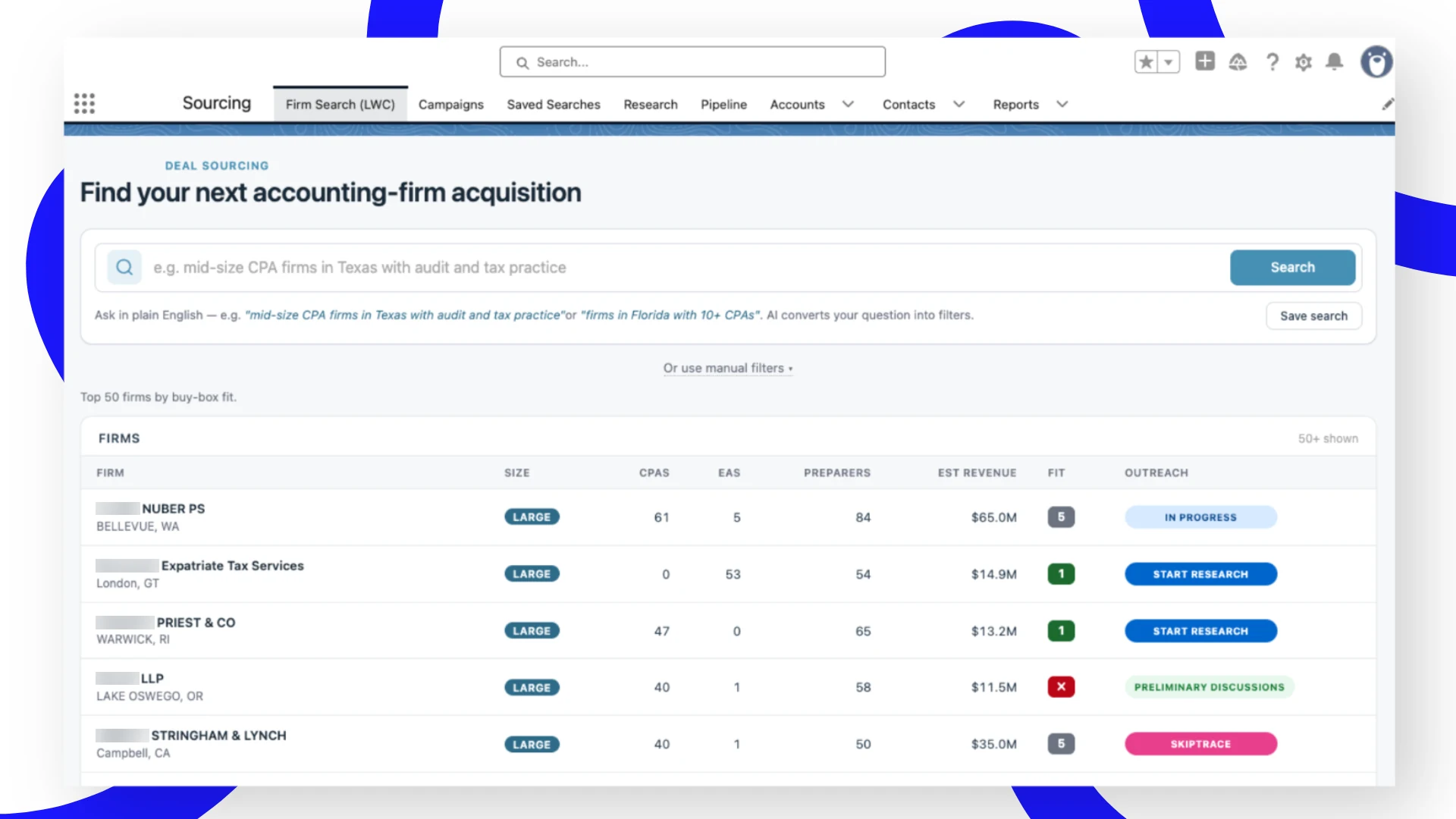
The defensible asset isn't the data anyone can buy — it's the AI layer that turns hundreds of thousands of anonymous firms into a ranked, qualified, contactable pipeline that competitors simply cannot reproduce.
— Joshua Guttilla, Founder & CEO
How It Works
1. AI Sourcing from Public Data
The engine begins by ingesting publicly available government and public records to build the most complete picture of the market that exists anywhere. From these sources it constructs a national directory of 380,704 accounting and tax firms, layered with structured signals about each firm: entity type, the kinds of returns it files, annual return volumes, and counts of credentialed professionals (CPAs, enrolled agents, and attorneys).
That public-record foundation is enriched by AI in ways static databases never attempt. The system analyzes firms' own websites at scale — 55,186 sites discovered and analyzed — and uses large language models to infer each firm's industry classification (rarely stated explicitly), extract service and niche specializations, and surface leadership and contacts. A separate AI-driven discovery path even surfaces new acquisition targets directly from news, pulling in firms the moment they appear in the public record.
2. AI Scoring & Qualification Against the Buy-Box
Raw scale is only useful if it can be ranked. The heart of the system is an AI scoring and qualification model that evaluates every firm against the California Family Office's precise buy-box.
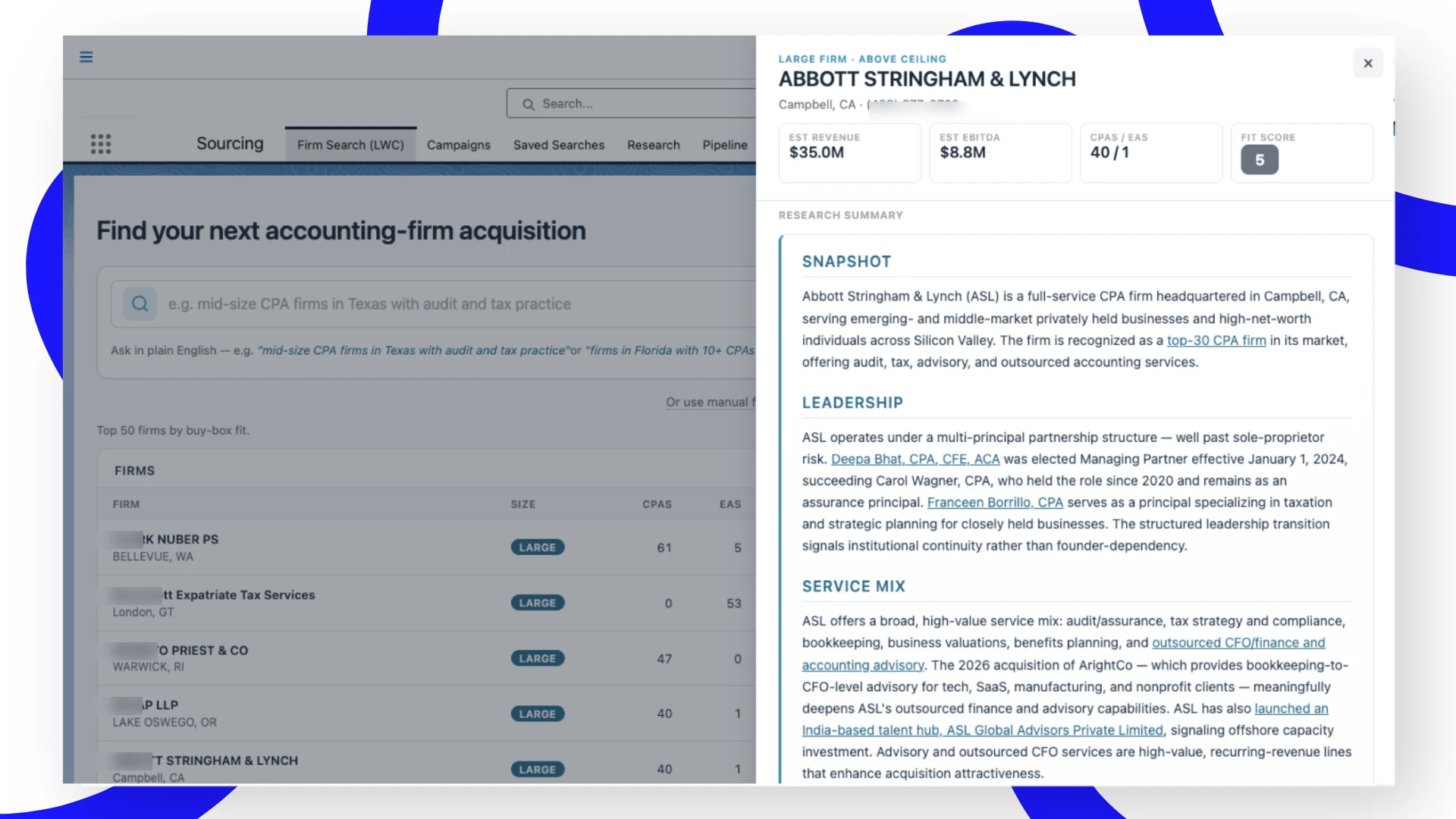
For each firm, the model produces two independent revenue estimates using different methods — one based on credentialed staffing, one based on filing volume — and then ships the more conservative figure, applying modifiers that dampen high-volume consumer tax mills so they don't masquerade as advisory firms. Crucially, the agreement between the two estimates becomes the confidence signal itself: when both methods land within range of each other, confidence is high; when they diverge, the firm is flagged for review. From the revenue estimate the model derives an EBITDA estimate and assigns a buy-box tier.
| Buy-box criterion | Threshold |
|---|---|
| Revenue floor | $900,000 |
| Revenue ceiling | $20,000,000 |
| Profitability estimate | Modeled from estimated revenue |
Every firm is sorted into one of four buy-box tiers at a glance:
- In box — inside the acquisition range and worth pursuing
- Below floor — too small to hit the revenue minimum
- Above ceiling — too large for the mandate
- Unknown — not enough data to place it yet
On top of that, a fit score ranks every in-box firm by how strong a match it is — surfaced as a single number from 1 (best fit) to 5, so the most acquirable targets rise straight to the top of the list. The score combines firm size, credentialed strength, and service mix, then layers in AI-analyzed website signals — high-value specializations (cost segregation, R&D credits, estate, international), attractive niches (real estate, high-net-worth, small business), and whether a named decision-maker is present.
The model also runs AI-powered acquisition detection: a heuristic flags firms that appear to have already been acquired, and an AI web-search verification step re-confirms that status with a stored verdict and reasoning, so already-sold firms are automatically excluded from outreach while legitimate alliance memberships are preserved.
To make all of this accessible, operators can query the engine in plain English — a natural-language AI search translates vague intent ("mid-size CPA firms with real-estate niches in California") into precise structured filters in seconds.
3. AI Contact Enrichment
A qualified firm is only actionable if you can reach a decision-maker. The system maps 596,000 decision-makers and 419,000 firm contacts across the universe, then layers AI-enriched, verified contact data on top.
For each priority firm, the engine identifies the right person, matches them to a professional profile using a custom confidence-scoring algorithm that weighs name, firm, and role signals and aggressively rejects wrong-person matches, finds and verifies a deliverable business email, and tags contacts into priority tiers. Only verified, sendable contacts are promoted into the outreach pool — a deliberate quality gate that keeps the campaigns clean.
4. Automated, AI-Personalized Outreach
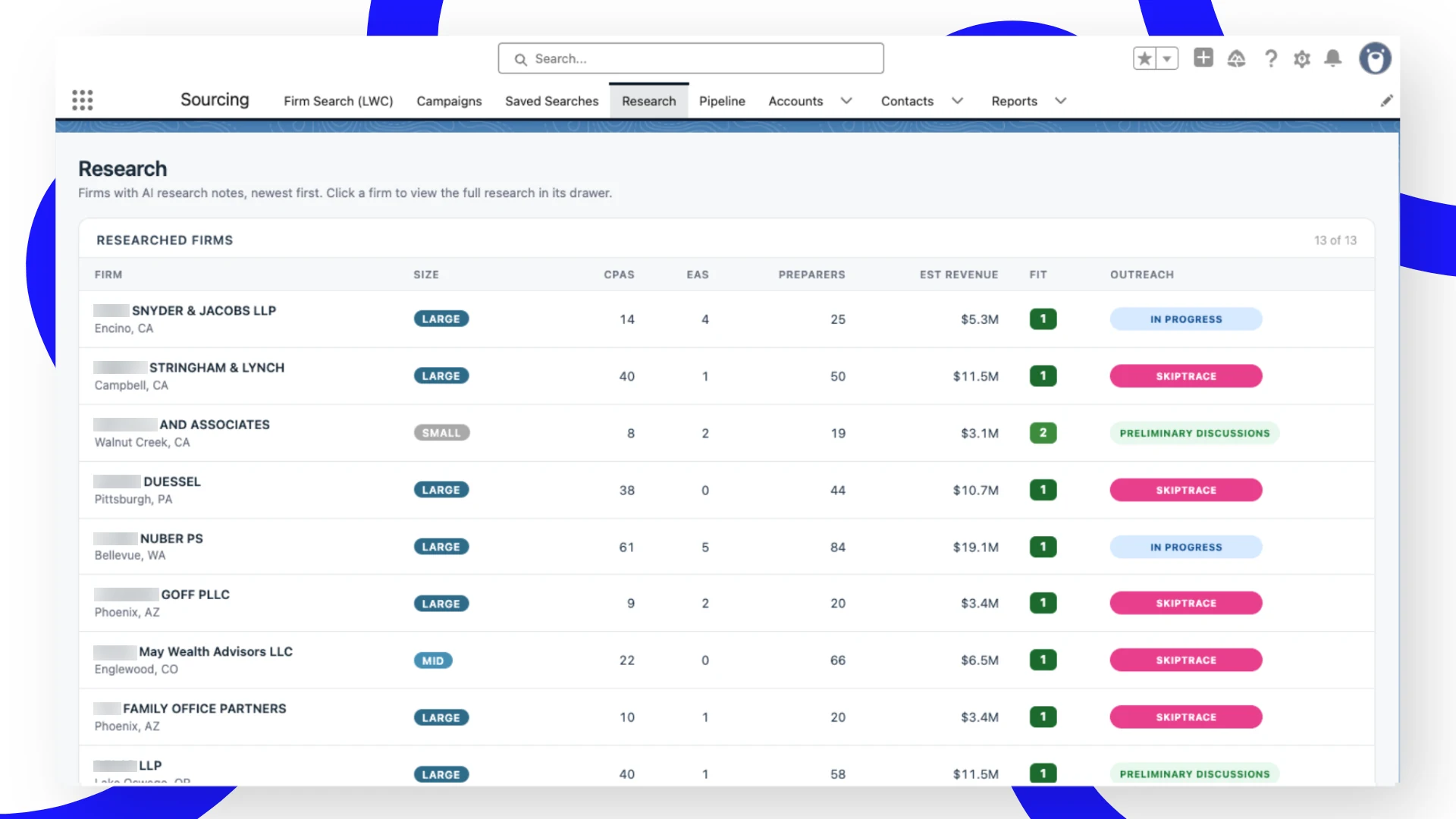
Qualified firms with verified contacts flow into automated, AI-personalized outreach campaigns. Each firm moves through a tracked pipeline, and its status updates automatically as real engagement happens:
- Not contacted — qualified and queued, ready for outreach
- In progress — actively moving through an outreach sequence
- No reply Interested Not interested — the outcome is captured automatically
A hard Do not contact flag overrides everything, and operators retain full manual control to update any firm's status at any point. The result is a closed loop: the system doesn't just find firms, it tracks which ones convert — building a proprietary record of outcomes that compounds in value over time.
Results & Scale
The engine gives the California Family Office a view of the accounting-firm market that no spreadsheet, CRM, or off-the-shelf database can rival.
| Capability | Before | With the AI engine |
|---|---|---|
| Market visibility | Fragmented lists, generic databases | 380,704 firms mapped nationally |
| Decision-maker reach | Manual lookups | 596,000 decision-makers mapped |
| Qualification | Analyst-by-analyst, slow | Every firm auto-scored against the buy-box |
| Web intelligence | None at scale | 55,186 firm websites AI-analyzed |
| Outreach | Spreadsheets and guesswork | Automated, AI-personalized, outcome-tracked |
- 380,704 accounting and tax firms identified from public records
- 596,000 decision-makers and 419,000 firm contacts mapped
- 800,000 credentialed preparers catalogued
- 55,186 firm websites discovered and AI-analyzed
- Every firm automatically scored, tiered, and qualified against the buy-box, with conservative revenue and EBITDA estimates and a self-checking confidence signal
From a Name in a Database to a Booked Conversation
A list is where most deal-sourcing tools stop. For the California Family Office, that's where the real work begins — and where this engine pulls away from anything a data vendor can sell.
Once the market is mapped and ranked, the system goes after each firm individually. It uses AI to identify the actual person who matters — the owner or managing partner at a small shop, the business-development or origination lead at a larger one — even when the firm has no team page and even when its everyday brand looks nothing like its legal name. It discovers that person's business email, runs automatic deliverability verification so only sendable contacts ever enter a campaign, and then launches an automated, AI-personalized cold-outreach sequence written from that firm's specific context — not a mail-merged template. Every firm moves through a tracked pipeline, and every reply, open, and booked meeting streams back automatically, advancing each firm's status and pinging the operator the moment something turns Interested or a Meeting Booked.
What the engine does end-to-end:
- Finds the real decision-maker at every firm — automatically, even where there's no obvious contact to find.
- Qualifies each match with AI scoring, discards the noise, and tiers contacts by who's most worth reaching first.
- Reaches the highest-value people first, through automated, AI-personalized campaigns across warmed sending identities.
- Tracks every firm to a reply, advancing its status without anyone touching a spreadsheet.
- Books the conversation — interested prospects are pointed straight to a calendar, with human-judgment overrides and a do-not-contact veto always on top.
What used to consume an analyst team for weeks — building lists, looking up owners, chasing down emails, and cold-calling — now runs as one automated pipeline that delivers in minutes. The buyer is reaching qualified firms before competitors have finished assembling their list. And for the operator, there are no spreadsheets, no CRM gymnastics, no manual lookups: they ask in plain English and get back one ranked, contactable list. Find, qualify, reach, book — the entire arc lives inside a single AI system.
The California Family Office didn't buy a bigger database. Automation Atlas built it an AI engine that sees the whole market, qualifies it firm by firm, and reaches the right people first — turning national-scale deal sourcing into a durable, compounding advantage.
For a buyer competing to consolidate a fragmented market, that is the difference between chasing deals and owning the funnel — and it is exactly the kind of AI-powered, outcome-focused system Automation Atlas builds.
More case studies
See how Automation Atlas builds AI engines that work

Healthcare: Prescriber Data & AI Outreach Engine
How Automation Atlas built an AI engine that maps 7.2M+ US healthcare providers from public records, qualifies the precise targets for a hea…
Automation Atlas
June 23, 2026

Financial Services: Meeting Booking Recovery AI Dialer
How Automation Atlas built an AI voice agent — powered by Anthropic's fast Claude Haiku model and an ElevenLabs voice — that instantly calls…
Automation Atlas
June 22, 2026